
This product is a high-speed isolated RS-485 transceiver with integrated transformer driver.
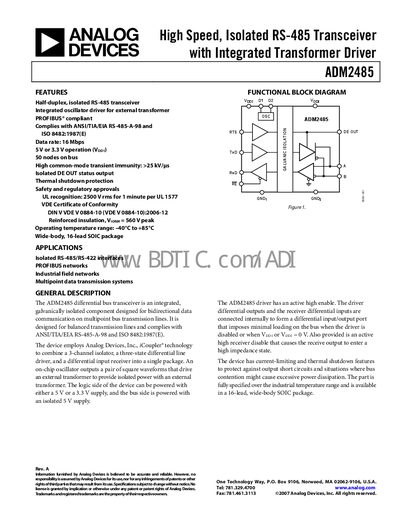
The ADM2485 is a galvanically isolated RS‑485/RS‑422 transceiver that combines a three‑channel isolator, differential line driver, and receiver in a single 16‑lead SOIC package. It operates from 5 V or 3.3 V logic supplies and provides an isolated 5 V bus side supply.
The device meets industrial standards such as ANSI/TIA/EIA‑RS‑485‑A‑98, ISO 8482, UL 1577 and VDE certifications, offering high common‑mode transient immunity and built‑in thermal shutdown protection for robust field‑bus applications.
| Maximum Data Rate | 16 Mbps |
|---|---|
| Operating Temperature Range | -40°C to +85°C |
| Isolation Voltage (Rated Dielectric) | 2500 Vrms (1‑minute) |
| Common‑Mode Transient Immunity | >25 kV/µs |
| Supply Voltage | 5 V or 3.3 V operation |
| Package | 16‑lead wide‑body SOIC |
The device supports a maximum data rate of 16 Mbps.
It is rated for 2500 Vrms isolation for a 1‑minute duration.
The transceiver operates from –40 °C to +85 °C.
The logic side can be powered by either a 5 V or a 3.3 V supply.