
This is a user manual for an audio device
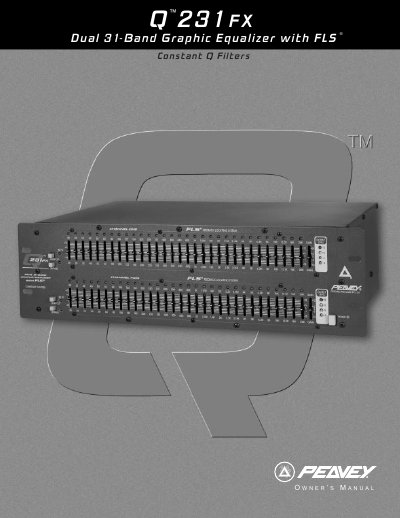
This manual begins with important safety instructions, warning users about dangerous uninsulated voltage, the risk of electric shock, and the fact that no user‑serviceable parts are inside the unit. Users are instructed to leave servicing to qualified personnel and to keep the enclosure dry.
The remainder of the guide explains the unit’s features, including the dual 31‑band graphic equalizer, constant‑Q filters, and the Feedback Locating System that uses LEDs to identify feedback‑prone frequencies. It also covers the back‑panel connections (XLR and 1/4" inputs/outputs), low‑cut filter, bypass mode, gain control, power requirements, and full technical specifications.
| Frequency Response | ±1 dB, 20 Hz – 20 kHz |
|---|---|
| Distortion | 0.005 % (20 Hz – 20 kHz) |
| Input Impedance | Balanced 20 kΩ |
| Output Impedance | 330 Ω |
| Maximum Input Level | +21 dBV (8 V RMS) |
| Maximum Output Level | +21 dBV (8 V RMS) |
| Input Headroom | 21 dB |
| Output Headroom | 21 dB |
| Output Noise (EQ bypass) | -101 dBV |
| Filter Q | 4.77 |
| Maximum Boost / Cut (Filter) | +12 dB / -18 dB |
| Low Cut Filter Frequency | 40 Hz |
| Power Consumption | Domestic: 120 V AC, 60 Hz, 20 W; Export: 230 V AC, 50/60 Hz, 20 W |
| Dimensions | 5.25" H × 19" W × 10.75" D |
When feedback is detected, an LED above the corresponding frequency band lights up; moving the fader for that band downward reduces or eliminates the feedback.
The unit requires 120 V AC, 60 Hz, 20 W for domestic use and 230 V AC, 50/60 Hz, 20 W for export markets.