
The document contains information about the products of BDTI C and ADI companies. It provides a detailed description of the features and characteristics of the products.
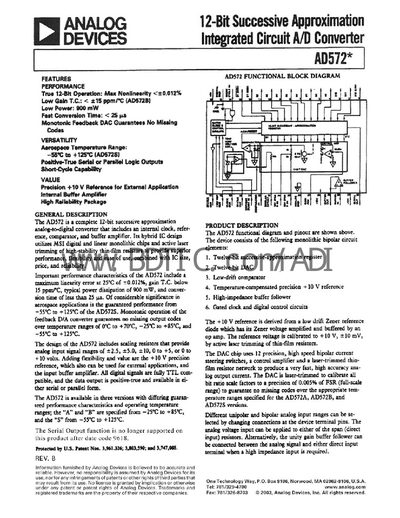
The AD572 is a complete 12‑bit successive‑approximation analog‑to‑digital converter that integrates an internal clock, reference, comparator, and buffer amplifier. It offers true 12‑bit operation, low gain temperature coefficient, low power consumption, and fast conversion time. The device is available in three versions (A, B, S) covering temperature ranges from –25 °C to +125 °C.
The datasheet provides detailed specifications, functional block diagrams, pin‑out information, analog and power connection diagrams, calibration procedures, timing diagrams, and application notes such as sample‑hold amplifier interfacing. It also includes ordering information and optional short‑cycle operation for reduced resolution modes.
| Resolution | 12‑bit |
|---|---|
| Power Dissipation | 925 mW |
| Operating Temperature Range | -55 °C to +125 °C |
| Gain Temperature Coefficient | 730 ppm/°C (‑25 °C to +85 °C) |
| Linearity Error | 0.012 % FSR (max) |
The AD572 provides true 12‑bit resolution.
It operates from –55 °C to +125 °C.
Typical power dissipation is 925 mW.