
The document describes the features and characteristics of the OP77 operational amplifier produced by Analog Devices. The operational amplifier has outstanding gain linearity, ultrahigh gain, low offset voltage drift, excellent temperature coefficient of offset voltage, high power supply rejection ratio, and low power consumption.
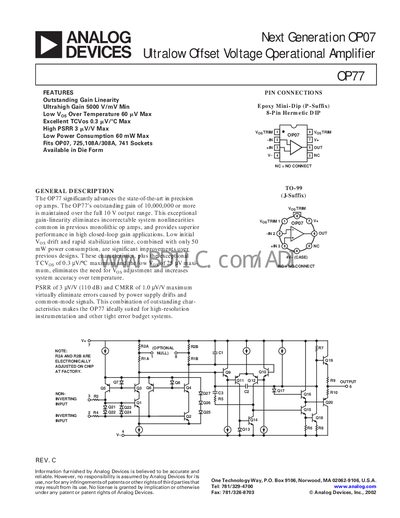
The OP77 precision op‑amp delivers an ultra‑low input offset voltage (as low as 10 µV) and exceptional gain linearity, making it suitable for high‑resolution instrumentation. It operates from a single supply up to +22 V and consumes only about 60 mW at no load.
The device is offered in TO‑99 (J‑suffix) and 8‑lead hermetic DIP (Z‑suffix) packages, with detailed electrical characteristics, absolute maximum ratings, and ordering information provided throughout the sheet.
| Gain | 5000 V/mV (minimum) |
|---|---|
| Power Consumption | 60 mW (no‑load, +15 V) |
| Power Supply Rejection Ratio (PSRR) | 3 pV/V (max) |
| Common‑Mode Rejection Ratio (CMRR) | 1.0 V/V (typ) |
| Output Voltage Swing | +14.0 V (typ) |
| Closed‑Loop Bandwidth | 0.6 MHz (typ) |
| Slew Rate | 0.3 V/µs (typ) |
The OP77 consumes about 60 mW at no load when powered from +15 V.
The absolute maximum supply voltage is +22 V.
The OP77 is offered in TO‑99 (J‑suffix) and 8‑lead hermetic DIP (Z‑suffix) packages.