
The OP471 is a monolithic quad op amp featuring low noise, high speed, high gain bandwidth, and unity-gain stability.
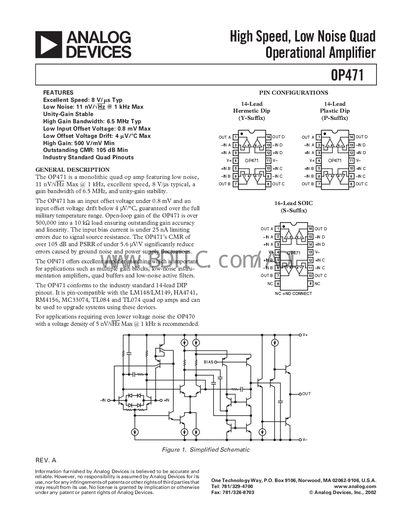
The OP471 quad operational amplifier offers excellent speed (8 V/µs typical) and very low voltage noise (11 nV/√Hz at 1 kHz). It features a unity‑gain stable design, low input offset voltage (0.8 mV max) and high gain bandwidth of 6.5 MHz typical, making it suitable for precision analog circuits.
The device is supplied in standard 14‑lead DIP and 16‑lead SOIC packages and is pin‑compatible with many legacy quad op‑amps such as the LM148/LM149 and TL074. Detailed electrical characteristics, absolute maximum ratings, and ordering information are provided in the following sections.
| Slew Rate | 8 V/µs (typ) |
|---|---|
| Gain Bandwidth Product | 6.5 MHz (typ) |
| Input Offset Voltage | 0.25–0.8 mV (typ), max 1.5 mV |
| Input Noise Voltage Density | 11 nV/√Hz @ 1 kHz (max) |
| CMRR | ≥ 105 dB (min) |
The OP471 has a typical gain‑bandwidth product of 6.5 MHz.
The input offset voltage ranges from 0.25 mV to 0.8 mV typical, with a maximum of 1.5 mV.
The OP471 provides a common‑mode rejection ratio of at least 105 dB.