
NXP ESD protection diodes provide advanced protection for FlexRay, LIN, and CAN systems. This selection guide provides information on the ESD protection diodes including pin configuration, packages, ESD rating, rated power, typical parasitic capacitance, maximum clamping current and maximum clamping voltage.
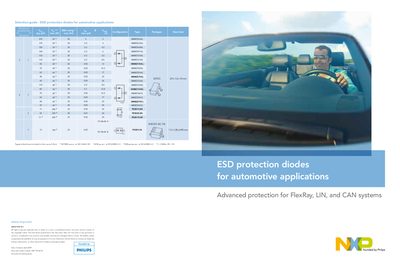
This guide presents NXP’s ESD protection diodes designed for automotive use. It lists part numbers, package types, and key electrical parameters for devices that protect FlexRay, LIN and CAN bus lines against electro‑static discharge and transient over‑voltage pulses.
The document includes typical application examples, key features such as bidirectional protection, ultra‑low leakage current, and compliance with IEC and MIL‑STD standards, helping designers choose the right diode for their ECU designs.
| ESD rating | up to 30 kV |
|---|---|
| Max. peak pulse power | 40 W (10/1000 µs) |
| Leakage current | < 1 nA |
| Capacitance (PESD1CAN) | 11 pF |
| Low clamping voltage (PESD2CAN) | 34 V at 1 A |
The diodes provide ESD protection of up to 30 kV.
They have an ultra‑low leakage current of less than 1 nA.
The PESD1CAN diode has a capacitance of about 11 pF.