
The DS5250 is a highly secure, four clocks-per-machine cycle, 100% 8051-instruction-set-compatible microprocessor in Maxim’s secure microcontroller family. It was designed to be the cryptographic engine of PIN pads, financial terminals, and any other application in which data security is paramount. A key feature of the device is that it encrypts its program memory and optionally its data memory with a hardware-based single- or triple-DES (data encryption standard) algorithm, making it almost impossible to extract information. It also implements block cipher encoding that uses block addresses to modify the encrypted data, further strengthening security. This makes the device ideal for storage and transmission of passwords, personal identification numbers, encryption keys, and other highly confidential information.
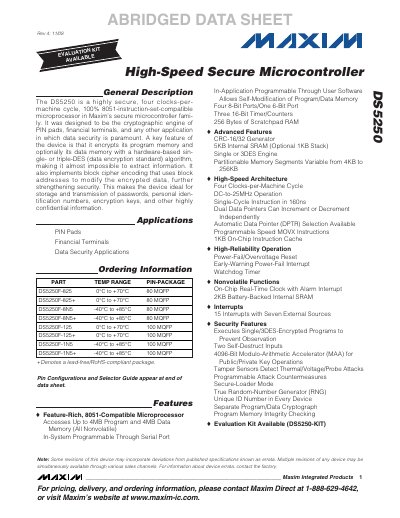
The DS5250 is a highly secure, four‑clocks‑per‑machine‑cycle, 8051‑compatible microcontroller designed for PIN pads, financial terminals and other data‑sensitive applications. It encrypts program memory and optionally data memory with single‑ or triple‑DES and uses block‑cipher encoding for added protection.
Key features include up to 4 MB of non‑volatile program and data memory, multiple I/O ports, three 16‑bit timers, a true random‑number generator, and a variety of security mechanisms such as tamper sensors and self‑destruct inputs. An evaluation kit (DS5250‑KIT) and extensive on‑chip peripherals make it suitable for secure storage and transmission of passwords, encryption keys and other confidential data.
| Program Memory | Up to 4 MB (non‑volatile) |
|---|---|
| Data Memory | Up to 4 MB (non‑volatile) |
| Internal SRAM | 5 KB (optional 1 KB stack) |
| Battery‑Backed SRAM | 2 KB |
| I/O Ports | Four 8‑bit ports, one 6‑bit port |
| Timers/Counters | Three 16‑bit timer/counters |
| Operating Frequency | DC‑to‑25 MHz |
| Instruction Cycle | Single‑cycle instruction in 160 ns |
| Interrupt Sources | 15 interrupts, 7 external |
| Random Number Generator | True RNG |
The DS5250 can address up to 4 MB of program memory.
It operates from DC up to 25 MHz.
The device provides four 8‑bit ports and one 6‑bit port.
Yes, it includes a true random‑number generator (RNG).