
The rat GAG ELISA kit is used to quantitatively measure the GAG content in rat serum, plasma, tissue homogenate, cell culture supernatant or other relevant liquids.
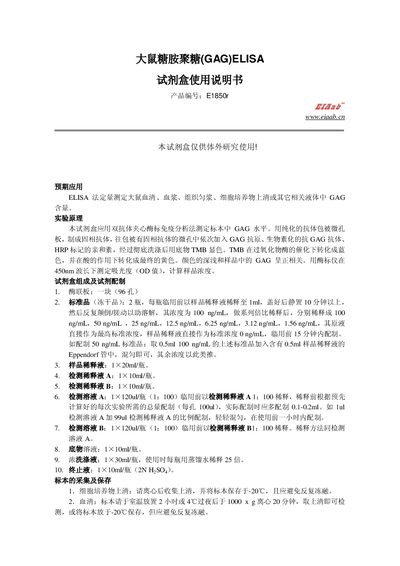
This manual describes the intended applications of the rat GAG ELISA kit, which include quantitative measurement of GAG in rat serum, plasma, tissue homogenates, cell‑culture supernatants, and other related liquids. It explains the sandwich ELISA principle, reagent composition, and detailed preparation of standards and detection solutions.
The document provides a complete assay workflow: sample handling, plate loading, incubation times, washing procedures (both manual and automated), substrate development, termination, and optical density reading at 450 nm. It also covers calculation of sample concentrations, specificity notes, detection range, storage conditions, and shelf‑life information. This manual is written in Chinese.
| Detection range | 1.56 ng/mL – 100 ng/mL |
|---|---|
| Storage temperature (long‑term) | -20 °C |
| Storage temperature (frequent use) | 2‑8 °C |
| Shelf life | 6 months |
The kit can quantify GAG in rat serum, plasma, tissue homogenate, cell‑culture supernatant, or other related liquids.
Dilute the 100 ng/mL standard stock with sample diluent to create a series of standards (100, 50, 25, 12.5, 6.25, 3.12, 1.56 ng/mL) and use 0 ng/mL as the blank.
Plot a standard curve using the log‑scaled concentration versus OD values, then determine sample concentrations from the curve and multiply by the dilution factor.