
Application Note: Using the SDA Reverse Sweep and Balance
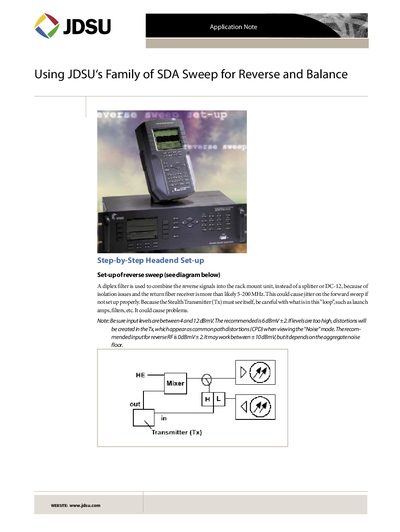
The note provides a step‑by‑step headend set‑up for reverse sweep, covering diplex filter use, input level recommendations (4‑12 dBmV, recommended 6 dBmV + 2), and telemetry configuration. It describes how to enable reverse sweep, set telemetry frequencies, and balance forward and reverse paths using the field unit’s configure menus.
Additional sections discuss common problems such as standing waves, spikes, and loss of communication, and give practical tips on sweep resolution, sweep point limits (500 points), and telemetry signal‑to‑noise requirements (>20 dB S/N). The document also outlines other applications of the portable stealth receiver and provides a list of useful shortcuts and diagnostics.
| Recommended input level (forward) | 6 dBmV +2 |
|---|---|
| Recommended input level (reverse) | 0 dBmV +2 |
| Telemetry level range | 20‑50 dBmV (2 dB steps) |
| Maximum telemetry level | 50 dBmV (40 dBmV older units) |
| Sweep point limit | 500 points |
| Field unit CW carrier power | 50 dBmV (40 dBmV older version) |
| DC blocking voltage | 200 V peak‑to‑peak (~100 Vac) |
Select “Enable reverse sweep” in the transmitter settings to allow reverse sweep operation.
The recommended reverse input level is 0 dBmV + 2 dB.
The instrument can store up to 500 sweep points.
Reverse telemetry must have a signal‑to‑noise ratio greater than 20 dB.