
E.coli Electro-Cells HB101 is an electroporation transformation kit for transforming small amounts of exogenous DNA.
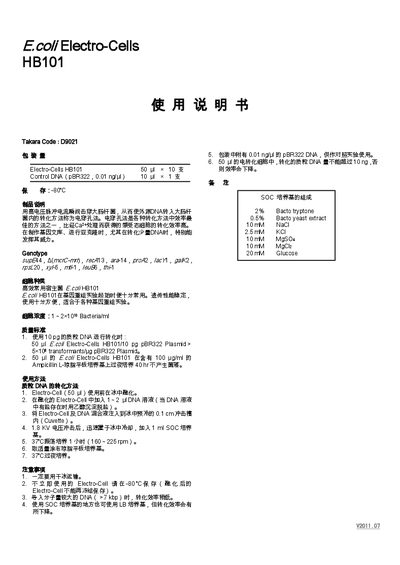
The Takara HB101 Electro-Cells are high‑efficiency competent E. coli cells designed for gene‑recombination experiments. They contain the genotype SUDE44, ADCR‑An1T, recA413, among others, and are supplied as 50 µL aliquots (10 × HB101) with control DNA (PBR322, 0.01 ng/µL). The cells are stored at –80 °C and must be thawed on ice before use.
The manual describes the electroporation protocol: thaw the Electro‑Cell, add 1–2 µL DNA (desalting if needed), mix in a pre‑chilled 0.1 cm cuvette, apply a high‑voltage pulse, immediately add 1 mL SOC medium, incubate at 37 °C for 1 h with shaking, then plate on agar. Precautions include dry‑ice transport, avoiding refreezing after thaw, and limits on DNA size and amount for optimal efficiency. This manual is written in Chinese.
| Cell concentration | 1 ~ 2 × 10^10 cells/mL |
|---|---|
| Recommended DNA amount for transformation | 10 pg plasmid DNA |
| Typical transformant yield | ≈5 × 10^8 transformants per 10 pg DNA |
Store the Electro‑Cell at –80 °C; after thawing it must not be refrozen.
The Electro‑Cell must be transported using dry ice.
SOC medium contains 2 % Bacto tryptone, 0.5956 % Bacto yeast extract, 10 mM NaCl, 2.5 mM K₂HPO₄, 10 mM MgSO₄, 10 mM MgCl₂, and 20 mM glucose.
DNA larger than 7 kbp may result in slightly lower transformation efficiency.