
This document describes the features and usage methods of E.coli Electro-Cells JM109. It is a highly efficient electro-transformation cell for E.coli, suitable for constructing gene libraries and performing subcloning. The cells have the characteristics of α-complementary selective host, which can be used to identify recombinant strains. The transformed cells have high stability and the transformation efficiency is up to 1×10⁹ transformants/μg pUC19 Plasmid. In addition, these cells can also serve as host cells for M13 phage vector DNA to prepare single-stranded DNA.
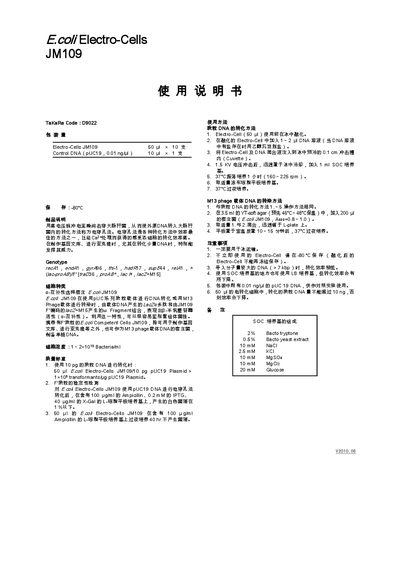
The Takara JM109 Electro‑Cells are high‑efficiency competent E. coli cells supplied with 0.01 ng/µL pUC19 DNA as a control. They should be stored at –80 °C and thawed just before use. The manual details the genotype of the JM109 strain and provides guidelines for handling the cells.
The document describes a step‑by‑step electroporation procedure, including cell preparation, DNA addition, electroporation at 15 kV, recovery in SOC medium, and plating on selective agar. Additional protocols for M13 phage DNA preparation and a list of precautions (e.g., using sterile water, avoiding repeated freeze‑thaw cycles) are also included. This manual is written in Japanese.
| Cell concentration | 1‑2 × 10^10 cells/mL |
|---|---|
| Control DNA in package | 0.01 ng/µL pUC19 |
| Typical transformation yield (10 pg DNA) | ~1 × 10^8 transformants per 50 µL |
| Electroporation voltage | 15 kV |
Approximately 1 × 10^8 transformants are obtained from 50 µL of cells with 10 pg DNA.
Thaw the Electro‑Cell, add 1‑2 µL DNA, mix and load into a pre‑cooled 0.1 cm cuvette, apply 15 kV, recover in SOC medium, incubate, and plate on selective agar.