
Key facts
- Brand
- ICOM
- Model
- IC-R3
- Documents
- 3
- Languages
- EN
- Last added
- 2026-09-28
Start here
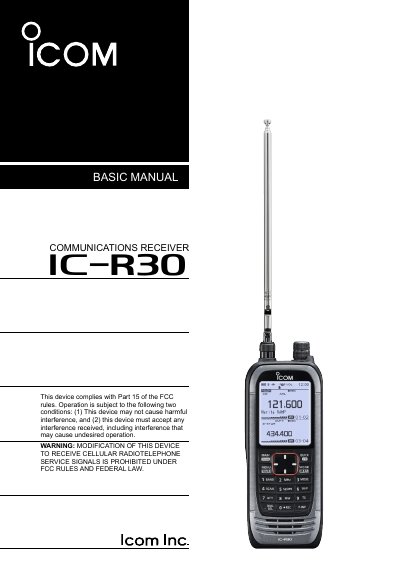
Icom IC-R30 Communications Receiver Basic Manual
This document serves as the Basic Manual for the Icom IC-R30 Communications Receiver. It outlines essential safety warnings, FCC compliance information, and key features of the device. The manual advises users to read all instructions before use and to save the document for future reference.
Read onlineIcom IC-R3 specifications
| Usable temperature range | −20 °C ~ +60 °C |
|---|---|
| Power supply requirement | 3.6 V DC (internal) / 5.0 V DC ±5 % (external/USB) |
| Dimensions (W × H × D) | 58 mm × 143 mm × 30.5 mm |
| Weight | 200 g |
All Icom IC-R3 documents by type
Disassembly, diagnostics and part numbers, for repair.
Day-to-day operation, settings and troubleshooting. Start here if the product is already set up.
Questions answered in these manuals
What is the power supply requirement for the IC‑R30?
The receiver needs a 3.6 V DC internal supply and a 5.0 V DC external supply with ±5 % tolerance (USB).
How many memory channels does the IC‑R30 provide?
The IC‑R30 offers 2 000 memory channels organized in 100 groups, plus an additional 400 channels for scan functions.
What are the operating temperature limits?
The receiver should not be used in areas with temperatures below -10°C or above 46°C.
What happens if I operate the receiver at high volume?
Operating at high volume levels may cause hearing damage, so you should reduce the volume or discontinue use if you experience ringing in your ears.
Can the IC-R30 receive cellular signals?
No, modification of this device to receive cellular radiotelephone service signals is prohibited under FCC rules and federal law.
What happens if I use a non-Icom battery?
Using third-party or counterfeit battery packs may cause smoke, fire, or cause the battery to burst.