
Key facts
- Brand
- Allied Telesis
- Model
- x900-series
- Documents
- 2
- Languages
- EN
- Last added
- 2012-07-09
Start here
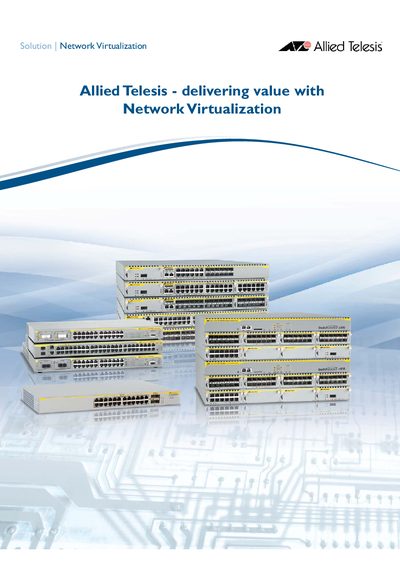
Allied Telesis x900 Series Switches Network Virtualization Solution Guide
The document describes how Allied Telesis leverages IT virtualization to maximize infrastructure value. Key concepts include the 'Virtualized Dual Backbone,' which replaces redundant hardware with a single virtual switch pair to improve efficiency and reduce energy consumption, and 'Network Service Virtualization,' which distributes services like authentication and DHCP across switches rather than relying on centralized appliances.
Furthermore, the text details how Allied Telesis enables multiple isolated networks to share a physical Ethernet infrastructure using identity-based allocation. This is achieved through technologies such as VLAN stacking (QinQ) for Layer 2 isolation and various overlay protocols for Layer 3 networks, ensuring that users can access their specific network regardless of physical location.
Allied Telesis x900-series specifications
| Height | 44.5 mm (+5.1 mm with rubber feet) |
|---|---|
| Width | 440 mm |
| Depth | 440 mm |
| Weight | ≤ 7.3 kg (unpackaged) |
| Operating Temperature Range | 0 °C to 50 °C |
Source: Allied Telesis x900 Series Switch and SwitchBlade x908 Hardware Reference Manual
All Allied Telesis x900-series documents by type
Questions answered in these manuals
What is a Virtualized Dual Backbone?
It is a high availability solution based on pairs of switches operating together as a single virtual switch, eliminating the need for expensive idle redundant equipment.
From: Allied Telesis x900 Series Switches Network Virtualization Solution Guide
How does Network Service Virtualization work?
It distributes network services like security and authentication across the switching infrastructure instead of tying them to single specialized appliances.
From: Allied Telesis x900 Series Switches Network Virtualization Solution Guide