
User manual for the TP4005 Joule's Law experiment apparatus, covering the experiment's purpose, principle, setup, procedure, results and safety notes.
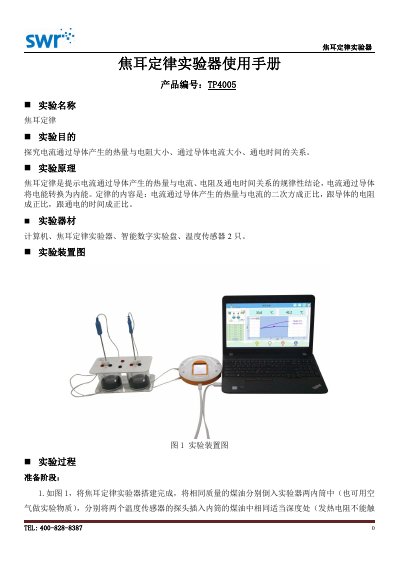
This three-page manual describes how to carry out a Joule's Law experiment with the TP4005 experiment apparatus. It states the purpose of the experiment, explains the principle that heat produced by current through a conductor is proportional to the square of the current, to the resistance and to the time, and lists the required equipment: a computer, the experiment apparatus, a smart digital experiment panel and two temperature sensors.
The manual then walks through the preparation and run phases step by step, including filling the two inner cylinders with equal masses of kerosene, inserting the temperature sensors, setting the student power supply to 6 V, choosing the resistance-comparison or current-comparison wiring, and using the experiment software to start, stop and plot the data. Example result graphs and four safety and storage notes close the document. This manual is written in Chinese.
| Product number | TP4005 |
|---|---|
| Temperature sensors included | 2 |
| Left cylinder resistor | 3 Ω |
| Student power supply setting | 6 V |
It investigates how the heat produced by current passing through a conductor depends on the resistance, the current and the time the current flows.
A computer, the Joule's Law experiment apparatus, a smart digital experiment panel and two temperature sensors.
The student power supply is set to 6 V before the experiment begins.
Do not touch the heated resistor with your hands, and do not place the temperature sensor probe too close to or in contact with the resistance wire.