
SICK TIM Series mini laser scanners for 2D area detection and contour measurement, covering detection TIM3xx and measurement TIM5xx models.
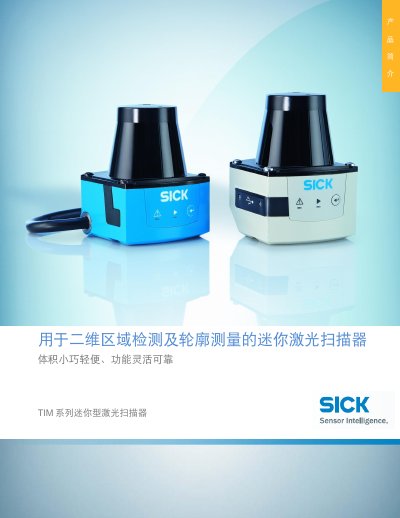
SICK TIM Series mini laser scanners are used for 2D area detection and contour measurement. The document covers the detection models TIM310, TIM320, TIM351 and TIM361, and the measurement models TIM510, TIM551 and TIM561. It explains the laser scanning principle and SICK's HDDM measurement technology.
The scanners use an infrared 850 nm laser and provide a 270° scan angle. The document describes detection and ranging modes, area setting modes, indoor and outdoor versions, technical specifications, ordering information and dimension drawings. This manual is written in Chinese.
| Scanning angle | 270° |
|---|---|
| Scanning frequency | 15 Hz |
| Light source | Infrared laser, 850 nm |
| Laser class | Class 1, eye-safe |
| Operating voltage (TIM310/TIM320/TIM510) | 10 V DC to 28 V DC |
| Power consumption | Typical 3 W without output load |
| Protection rating (indoor models) | IP65 |
| Protection rating (outdoor models) | IP67 |
| Weight (indoor models) | 150 g excluding cable |
| Weight (outdoor models) | 250 g excluding cable |
TIM3xx models are detection models that scan preset areas and output detection results through switching outputs. TIM5xx models are measurement models that output 2D point-matrix scan data through a data interface.
It uses SICK's patented HDDM technology, which is based on time-of-flight measurement.
The document lists equipment collision avoidance, object detection and area security as typical uses.
The scan angle is 270°, and working distance is up to 4 m or 10 m depending on the model.