
Datasheet for the ON Semiconductor MC74LVX245 octal bus transceiver, covering features, pin functions, ratings, electrical characteristics, and packaging.
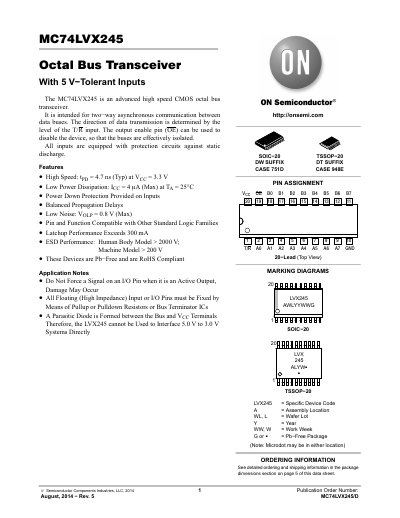
The MC74LVX245 is a CMOS octal bus transceiver intended for two-way asynchronous communication between data buses. The direction of data transmission is determined by the level of the T/R input, and the output enable pin (OE) can disable the device so the buses are effectively isolated. All inputs have protection circuits against static discharge.
Recommended operating conditions include a 2.0 V to 3.6 V DC supply voltage, 0 V to 5.5 V input voltage on T/R and OE, and an operating temperature of -40 °C to +85 °C. The datasheet includes maximum ratings, DC and AC electrical characteristics, capacitive and noise characteristics, switching waveforms, test circuits, ordering information, and package dimensions. Application notes state that a signal should not be forced on an I/O pin when it is an active output, that floating input or I/O pins must be fixed with pullup or pulldown resistors or bus terminator ICs, and that a parasitic diode between the bus and VCC terminals means the LVX245 cannot directly interface 5.0 V to 3.0 V systems.
| DC Supply Voltage (VCC) | 2.0 V to 3.6 V |
|---|---|
| DC Input Voltage (T/R, OE) | 0 V to 5.5 V |
| DC Output Voltage | 0 V to VCC |
| Operating Temperature | -40 °C to +85 °C |
| Propagation Delay | 4.7 ns typical at VCC = 3.3 V |
| ESD Performance | Human Body Model > 2000 V; Machine Model > 200 V |
| Latchup Performance | Exceeds 300 mA |
| Pb-Free and RoHS | Compliant |
It is intended for two-way asynchronous communication between data buses.
The direction is determined by the level of the T/R input.
No. A parasitic diode is formed between the bus and VCC terminals, so the LVX245 cannot be used to interface 5.0 V to 3.0 V systems directly.
They must be fixed with pullup or pulldown resistors or bus terminator ICs.