
Installation guide for Endress+Hauser CCS140/CCS141 chlorine sensors, covering mounting on CCA250 bracket, specifications, and setup.
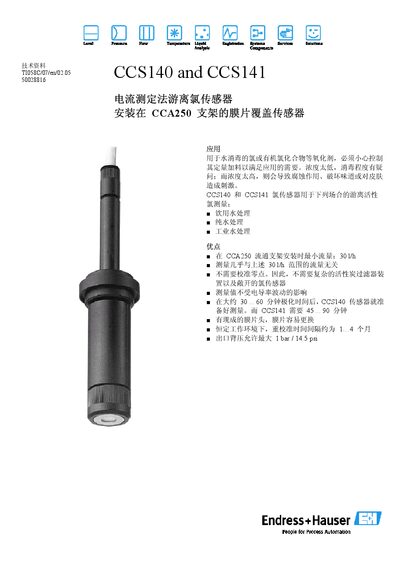
The CCS140 and CCS141 current‑measurement chlorine sensors are designed for free‑active chlorine monitoring in drinking‑water, pure‑water, and industrial‑water treatment. They operate by measuring the current generated when hypochlorous acid diffuses through a membrane and is reduced at the gold cathode.
The guide provides step‑by‑step installation on the CCA250 flow‑through bracket, required minimum flow of 30 l/h, back‑pressure limit of 1 bar, and polarity‑time requirements (60 min for CCS140, 90 min for CCS141). It also lists environmental limits, mechanical dimensions, and recommended accessories.
| Measurement range (CCS140) | 0.05 – 20 mg Cl₂/L |
|---|---|
| Measurement range (CCS141) | 0.01 – 5 mg Cl₂/L |
| Depolarization current (CCS140) | ≈ 25 nA per mg Cl₂/L |
| Depolarization current (CCS141) | ≈ 80 nA per mg Cl₂/L |
| Minimum flow rate (CCA250 bracket) | 30 l/h |
| Maximum back pressure | 1 bar (14.5 psi) |
| IP protection rating | IP68 |
The flow must be at least 30 l/h; lower flow can trigger an alarm and lock the dosing pump.
The sensor can tolerate a back pressure up to 1 bar (14.5 psi).
The sensor is rated IP68.