
Diodes AP3401 EVB user guide: 1A step-down DC-DC converter features, EV board schematic, output voltage setting, BOM and test results.
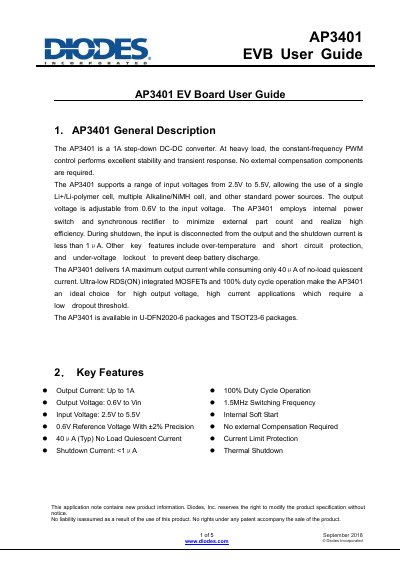
This user guide from Diodes Incorporated covers the AP3401 EVB, an evaluation board for the AP3401 1A step-down DC-DC converter. It first describes the converter itself: constant-frequency PWM control at heavy load, no external compensation needed, a 2.5V to 5.5V input range, an output adjustable from 0.6V up to the input voltage, and shutdown current below 1 µA. Key features, the EV board schematic for both the U-DFN2020-6 and TSOT23-6 package versions, and a short description of the evaluation board follow.
The rest of the guide gives practical evaluation information: an EV board view, a resistor selection table for setting the output voltage (3.3V, 1.8V and 1.0V examples), guidance on selecting input/output capacitors, the voltage-setting resistors and the inductor, a BOM list for the AP3401 evaluation board, and a converter operation waveform measured at 1A output current.
| Output Current | Up to 1A |
|---|---|
| Input Voltage | 2.5V to 5.5V |
| Output Voltage | 0.6V to Vin |
| Reference Voltage | 0.6V with ±2% precision |
| No Load Quiescent Current | 40µA (typ) |
| Shutdown Current | less than 1 µA |
| Switching Frequency | 1.5MHz |
| Duty Cycle | 100% duty cycle operation |
| Packages | U-DFN2020-6 and TSOT23-6 |
| EVB default output voltage | 1.8V (Vin = 2.5V to 5.5V) |
The AP3401 supports input voltages from 2.5V to 5.5V, which allows use of a single Li+/Li-polymer cell or multiple Alkaline/NiMH cells.
It is set with the resistor divider R1 and R2 using Vout = (1 + R1/R2) × Vref, where Vref is 0.6V. The board's listed values give 1.8V output.
A 2.2uH inductor is recommended, with a saturation current higher than the output current and low DCR for good efficiency.
Low-ESR X5R/X7R ceramic capacitors are recommended, with Cin and Cout capacitances greater than 4.7uF and 10uF respectively.
The AP3401 delivers 1A maximum output current while consuming only 40µA of no-load quiescent current.