
The ATmega16A datasheet provides specifications, pin configurations, electrical characteristics, and functional descriptions for Atmel's 8-bit AVR…
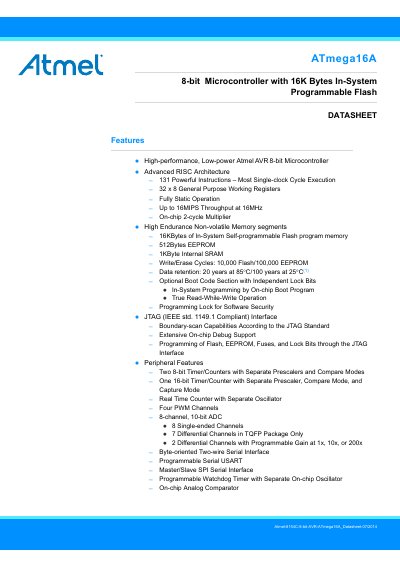
The ATmega16A is a low‑power CMOS 8‑bit microcontroller based on Atmel's AVR enhanced RISC architecture. It offers up to 16 MIPS at 16 MHz, 16 KB of flash, 512 B EEPROM, 1 KB SRAM, and a rich set of peripherals including multiple timers, a 10‑bit ADC, USART, SPI, I²C, and JTAG debugging.
The document details pin‑out for PDIP, TQFP and QFN/MLF packages, electrical limits (2.7‑5.5 V, 0‑16 MHz), power‑down consumption (<1 µA), and extensive register descriptions. It also covers programming methods, boot‑loader support, and timing diagrams for all major modules.
| Flash program memory | 16 KB |
|---|---|
| EEPROM | 512 B |
| SRAM | 1 KB |
| Operating voltage | 2.7 V – 5.5 V |
| Maximum clock speed | 16 MHz |
| Active power consumption (1 MHz, 3 V, 25 °C) | 0.6 mA |
| Idle mode power consumption | 0.2 mA |
| Power‑down mode current | < 1 µA |
| Programmable I/O lines | 32 |
| Package options | 40‑pin PDIP, 44‑lead TQFP, 44‑pad QFN/MLF |
| ADC resolution | 10‑bit |
| Timer/Counters | Two 8‑bit, one 16‑bit |
The ATmega16A provides 16 KB of In‑System Self‑programmable Flash program memory.
It operates from 2.7 V up to 5.5 V.
The device has 32 programmable I/O lines.
The ATmega16A can run up to 16 MHz.