
The document describes a high-performance, low-power AVR® 8-bit microcontroller with advanced RISC architecture, high endurance non-volatile memory, JTAG interface, and various peripheral features.
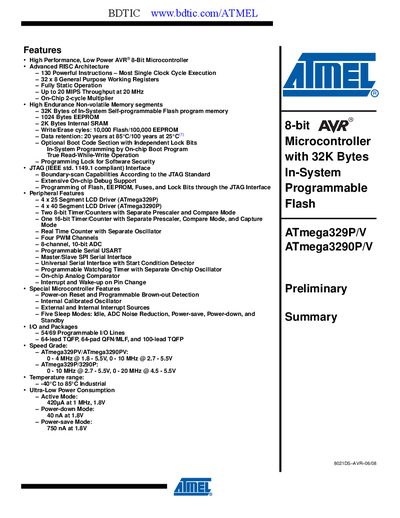
The ATmega329P and ATmega3290P are low‑power CMOS 8‑bit microcontrollers based on the AVR enhanced RISC architecture. They provide up to 20 MIPS at 20 MHz, multiple timers, an 8‑channel 10‑bit ADC, JTAG debugging, and a built‑in LCD driver. Power‑saving modes allow ultra‑low current consumption, making the devices suitable for battery‑operated embedded applications.
The document includes a complete feature list, pin‑out diagrams for the various packages (64‑lead TQFP, 64‑pad QFN/MLF, 100‑lead TQFP), electrical characteristics, timing diagrams, and errata for each silicon revision. It also describes the programming interfaces (SPI, JTAG, In‑System Programming) and the available development tools.
| Flash memory | 32 KB |
|---|---|
| EEPROM | 1 KB |
| SRAM | 2 KB |
| Programmable I/O lines | 54 (ATmega329P) / 69 (ATmega3290P) |
| ADC resolution | 8‑channel, 10‑bit |
| Operating voltage | 1.8 V – 5.5 V |
| Maximum clock speed | 20 MHz |
| Active mode current | 420 µA at 1 MHz, 1.8 V |
| Power‑down current | 40 nA at 1.8 V |
| Temperature range | -40 °C to 85 °C (industrial) |
The device contains 32 KB of In‑System Self‑programmable Flash memory.
The ATmega329P provides 54 programmable I/O lines, while the ATmega3290P provides 69.
In active mode the part draws about 420 µA at 1 MHz and 1.8 V.
It is available in 64‑lead TQFP, 64‑pad QFN/MLF, and 100‑lead TQFP packages.