
The LTC2636 is an octal 12-bit DAC with internal reference voltage and rail-to-rail output buffer. The device communicates through a simple SPI/MICROWIREtm compatible interface.
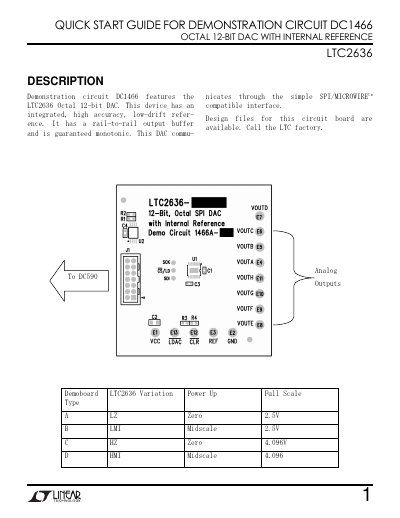
DC1466 is a demonstration circuit for the LTC2636 octal 12-bit DAC with an integrated reference. It provides rail-to-rail buffered outputs and communicates through an SPI/MICROWIRE compatible interface.
To use it, connect DC1466 to a DC590 USB serial controller and then to a host PC, then run the supplied evaluation software. Hardware connections include eight DAC output turrets, a reference turret, power, and ground.
| DAC resolution | 12-bit |
|---|---|
| Number of DAC channels | 8 |
| Output buffer | Rail-to-rail |
| Digital interface | SPI/MICROWIRE compatible |
| Reference | Integrated high accuracy low-drift |
| Monotonicity | Guaranteed monotonic |
Connect DC1466 to a DC590 USB serial controller with the supplied 14 conductor ribbon cable, then connect the DC590 to the host PC with a standard USB A/B cable.
Normally it is powered by the DC590 controller.
The eight DAC outputs are brought out to turrets labeled VOUTA through VOUTH.
Yes, an external reference may be applied to the Ref turret after changing the setting in the QuickEval software.