
Tuttnauer offers a wide range of sterilizers, including table-top sterilizers, industrial sterilizers, laboratory sterilizers, and washer disinfectors.
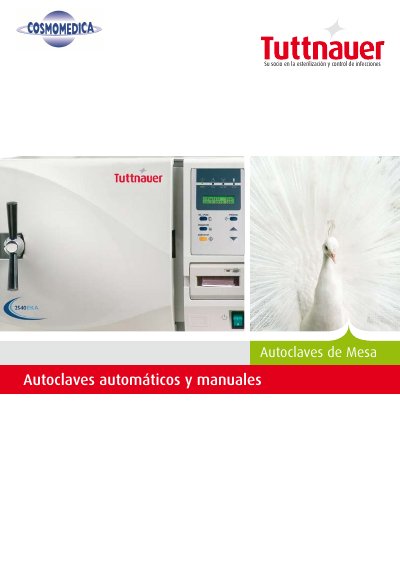
This Tuttnauer company and product leaflet presents the company's sterilization and infection-control offering: a wide range of benchtop autoclaves for dental clinics and small to medium clinics or as a secondary unit in medical centers and hospitals, cleaning, disinfection and sterilization products for central sterile supply departments, industrial sterilizers for hospitals and research institutes, laboratory autoclaves in various sizes, and washer-disinfectors for dental clinics, hospitals and laboratories. The text says the company was founded in 1925, that its products are supplied in more than 100 countries, and that its autoclaves meet standards including FDA, ASME, ISO and the European medical device directives.
The leaflet describes the automatic series E, EK, EA and EKA and the manual M/MK series. Automatic models feature microprocessor control, preprogrammed cycles, pressure and temperature monitoring, an optional built-in printer, a PC connection port, cycle recovery after power failure and a water-level detector with automatic shutoff. Tables list chamber volumes and cold- and hot-chamber cycle times for models such as 1730EK, 2340E, 2540E, 3140E, 3850E, 3870E, 2340EA, 2540EA, 3850EA, 3870EA, 2340EKA and 2540EKA. The EK models use a fast mode that cuts the heating stage by more than 50%, and the EA and EKA models add an air pump with a HEPA filter for drying with the door closed. The manual M/MK series is presented as easy to operate without specially trained staff, with a door lock that prevents opening while the chamber is pressurized. This manual is written in Spanish.
| Chamber volume, large capacity models | 65 and 85 liters |
|---|---|
| Chamber and door material | Stainless steel type 316L with electro-polished finish |
| Heating-stage reduction in EK fast mode | More than 50% |
| 2340E chamber volume and cycle time | 19 liters; 23 min cold chamber / 16 min hot chamber |
| 3870E chamber volume and cycle time | 85 liters; 31 min cold chamber / 21 min hot chamber |
| 1730EK chamber volume and cycle time | 7.5 liters; 14 min cold chamber / 11 min hot chamber |
| Standards and directives | PED, MDD, ASME, UL / EN 61010-1, FDA, ISO |
| Low water level protection | Water level detector with automatic shutoff |
| Cycle documentation | Built-in printer (optional) and PC connection port |
Both have two operating modes, but the EK fast mode shortens the heating stage by more than 50%, making sterilization cycles faster; the standard E model offers the reliability features of the automatic autoclaves with microprocessor control.
The EA and EKA models have an air pump that allows drying with the door closed, using a HEPA air filter.
No. The manual M/MK autoclaves are described as easy to use, so no specially trained personnel is required to operate them.
The manual autoclaves have a door lock, and both automatic and manual units have a door protection device against opening at high pressure.