
The document describes the features of the Photo Power TRIAC, including the input and output characteristics.
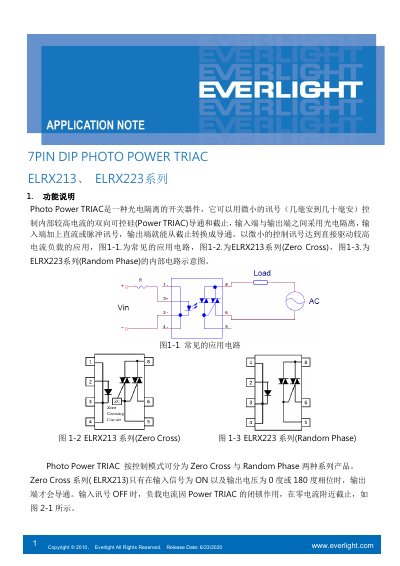
The ELRX213 and ELRX223 are 7-pin DIP photo power TRIACs from Everlight. They use an infrared LED to optically isolate and trigger an internal power TRIAC, allowing a small control signal (a few milliamps to tens of milliamps) to switch higher current loads. Two control modes are available: the ELRX213 zero-cross series conducts only when the output voltage is at 0° or 180° phase, while the ELRX223 random-phase series conducts immediately when the input signal is ON.
This application note covers input characteristics such as LED forward voltage and turn-on time versus LED current, output characteristics including on-state current derating above 40°C, off-state leakage current, and inhibit voltage. It also provides usage precautions for noise suppression on both input and output sides, and detailed snubber circuit design recommendations for inductive loads. This manual is written in Chinese.
| Snubber Capacitance | C=0.1~0.2uF |
|---|---|
| Snubber Resistance (110V Line) | R=10~100 Ω |
| Snubber Resistance (220V Line) | R=20~100 Ω |
| Snubber Resistor Power Rating (110V Line) | 1/2W |
| Snubber Resistor Power Rating (220V Line) | 2W or more |
| Snubber Capacitor Voltage Rating (110V Line) | 250V~400V |
| Snubber Capacitor Voltage Rating (220V Line) | 400~600V |
The ELRX213 is a zero-cross series that conducts only when the input signal is ON and the output voltage is at 0° or 180° phase, while the ELRX223 is a random-phase series that conducts immediately when the input signal is ON.
A general recommendation is C=0.1uF and R=20~100 Ω. For 110V lines use R=10~100 Ω with a 1/2W resistor; for 220V lines use R=20~100 Ω with a 2W or higher resistor.
Input noise can cause malfunction or damage, so an R,C filter circuit should be used to absorb it. Output noise from switching can be limited with a snubber circuit or varistor, and circuit traces should be kept short to reduce inductance.