
O-AH07 Explosion Proof & Harsh Environment
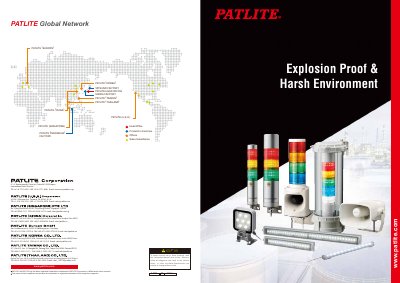
This PATLITE document presents the company's range of visual and audible signaling products intended for explosion proof and harsh environment applications. It opens with an introduction to PATLITE and its production system, then explains the conditions under which an explosion can occur and the protective measures used to minimize the risk.
The remaining sections explain how explosive environments are categorized into Zone 0, Zone 1 and Zone 2 for gases and vapors, and Zone 20, Zone 21 and Zone 22 for dust, with examples of a tank and a mill feed hopper. A classification table compares the ATEX, IEC, NEC505 and NEC500 groupings, and a list of branches shows typical hazardous applications such as power generation, woodworking, metal-work, food and beverage, refinery, pharmaceutical and chemical operations.
| Prerequisites for an explosion | Source of ignition, oxygen and combustible substances |
|---|---|
| Protective measures to minimize explosion risk | Limit concentration to a safe level, avoid combustible substances, increase ventilation, prevent the ignition, restrict explosive effects to a negligible level |
| Gas/vapor zone categories | Zone 0, Zone 1, Zone 2 |
| Dust zone categories | Zone 20, Zone 21, Zone 22 |
| Referenced area classification standards | ATEX EN60079-10 / EN61241-10, IEC IEC60079-10 / IEC61241-10, NEC505, NEC500 |
An explosion requires a source of ignition, oxygen and combustible substances together; if one component is missing, no explosion will take place.
Zone 1 is an area where an explosive atmosphere of flammable gas, liquid or vapor mixed with air can occasionally occur during normal operating conditions.
Inside the feed hopper and filter, where the dust and air mixture is present, the area is Zone 20, while around the hopper where a potentially flammable atmosphere exists temporarily it is Zone 22.
The document lists limiting concentration to a safe level, avoiding combustible substances, increasing ventilation, preventing ignition and restricting explosive effects to a negligible level.