
This guide describes how to use Texas Instruments’ ESD devices to protect systems from the damaging effects of electrostatic discharge (ESD) and electromagnetic interference (EMI).
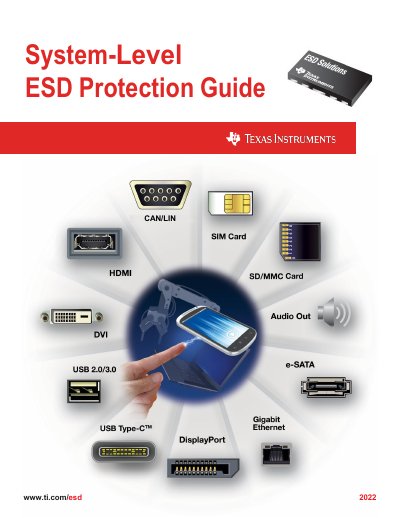
The Texas Instruments System-Level ESD Protection Guide 2022 explains system-level ESD and EMI protection and why device-level CDM and HBM specifications are not sufficient for system protection. It describes ESD protection diodes connected between the interface connector and IC, and notes that TI stand-alone ESD devices are intended to protect system ICs while maintaining signal integrity.
The guide presents ESD solutions by application for antenna, audio, CAN, Ethernet, HDMI, pushbutton/keypad, LIN, SD/SIM card, USB Type-C and 4-20-mA loop circuits. It also defines working voltage, IEC 61000-4-2 rating, capacitance, channels and clamping voltage at 16-A TLP, with selection tables listing device examples and package options.
| TPD1E0B04DPY working voltage | ±3.6 V |
|---|---|
| TPD1E0B04DPY capacitance | 0.15 pF |
| TPD1E01B04DPY IEC 61000-4-2 rating | 15/17 kV contact/air gap |
| ESD2CAN24DBZ working voltage | ±24 V |
| ESDS314DBV IEC 61000-4-2 rating | 30/30 kV contact/air gap |
| TPD1E10B09DPY capacitance | 10 pF |
ESD protection diodes are connected to each signal line between the interface connector and the IC; during an ESD strike the diode breaks down and diverts current to ground.
The guide states that CDM and HBM device-level specifications are not sufficient to protect devices in a system because system-level ESD strikes carry higher energy.
The CAN table lists ESD2CAN24DBZ, ESD2CAN24DCK, ESD752DBZ and ESD752DCK, with ±24-V working voltage and 30/30-kV contact/air-gap ratings.
The rating includes a contact rating and an air-gap rating, showing the maximum voltage the ESD device can withstand in each case.