
AD8230 is a low drift, differential sampling, precision instrumentation amplifier suitable for thermocouple and bridge sensor applications. It features high common mode rejection ratio, rail-to-rail input and output, low offset voltage and drift, etc.
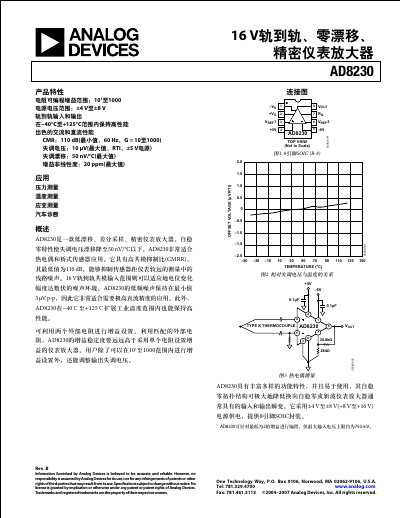
The document describes the AD8230, a precision instrumentation amplifier featuring rail-to-rail input and output, high common-mode rejection ratio (CMRR), and excellent AC/DC performance. It is designed for use with thermocouples and bridge sensors, supporting a wide power supply range from ±4 V to ±8 V while maintaining high performance across an extended industrial temperature range of −40°C to +125°C. This manual is written in Chinese.
| Offset Voltage (RTI) | 10 µV max |
|---|---|
| Offset Drift | 50 nV/°C max |
| Gain Range | 2 to 1000 V/V |
| Power Supply Range (Dual) | ±4 V to ±8 V |
| Operating Temperature Range | -40°C to +125°C |
The maximum RTI offset voltage is 10 µV when V+IN = V−IN = 0 V.
The programmable gain range is from 2 to 1000.
Yes, it is specifically designed and suitable for thermocouple and bridge sensor applications.