
This article introduces the design of a high-precision, low-cost, single-phase watt-hour meter based on ADE7757. The meter is designed for single-phase two-wire distribution systems and features a highly integrated system and direct drive of electromechanical counters.
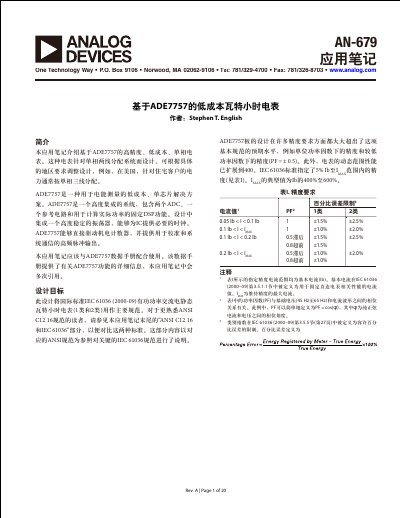
This application note introduces a high-precision, low-cost, single-phase watt-hour meter design based on the ADE7757 integrated system. The design targets IEC 61036 Class 1 and Class 2 accuracy requirements for single-phase two-wire distribution systems and can be adjusted for specific regional standards like ANSI C12.16. The ADE7757 provides a complete solution including two ADCs, a reference circuit, and fixed DSP functions for calculating real power, along with an integrated stable oscillator. This manual is written in Chinese.
| Accuracy Class | Class 1 and Class 2 |
|---|---|
| Dynamic Range | 400:1 |
| Basic Current (Ib) | 5 A |
| Maximum Current (IMAX) | 30 A |
| Meter Constant | 100 imp/kWh |
| Calibration Constant | 1600 imp/kWh |
| Shunt Resistance | 350 micro-ohms |
| Line Voltage | 220 V |
| Reference Circuit Temperature Coefficient | 30 ppm/°C (typical) |
The design primarily targets IEC 61036 Class 1 and Class 2 accuracy requirements.
The meter is calibrated by attenuating the line voltage to 61.5 mV rms using a resistor divider network.
The high-frequency output is used to speed up the calibration process and verify meter function and accuracy in a production environment.