
The RHF350 is a high-speed low-noise amplifier from STMicroelectronics with a bandwidth of 550 MHz, a static current of 4.1 mA, a slope of 940 V/µs, an input noise of 1.5 nV/√ Hz, a distortion of -66 dBc, a minimum output swing of 2.8 Vpp, and a 5 V power supply.
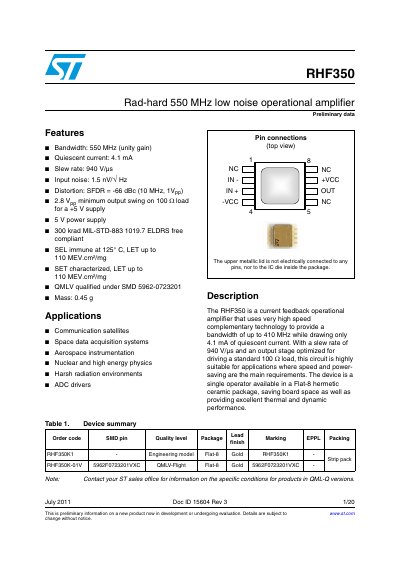
The RHF350 is a current feedback operational amplifier designed for very high speed applications with a bandwidth of up to 410 MHz and a slew rate of 940 V/us. It operates from a single 5 V power supply with a quiescent current of only 4.1 mA. The device is optimized for driving a standard 100 Ω load and is available in a Flat-8 hermetic ceramic package.
| Bandwidth | 550 MHz (unity gain) |
|---|---|
| Quiescent current | 4.1 mA |
| Slew rate | 940 V/us |
| Input noise | 1.5 nV/V Hz |
| Distortion | SFDR = -66 dBc (10 MHz, 1Vpp) |
| Output swing | 2.8 Vpp minimum on 100 Ω load |
| Supply voltage | 5 V |
| Radiation tolerance | 300 krad MIL-STD-883 1019.7 ELDRS free compliant |
The operating free-air temperature range is -40 to +85 °C.
The maximum supply voltage is 6 V.
The device operates from -40 to +85 °C.
The typical quiescent current is 4.1 mA.