
The MM54C192 and MM74C192 are BCD counters, while the MM54C193 and MM74C193 are binary counters. Both counters support counting from 0 to 9 and can be used to perform addition and subtraction operations, respectively. The counters also have carry and borrow outputs, so they can be cascaded using no external circuitry.
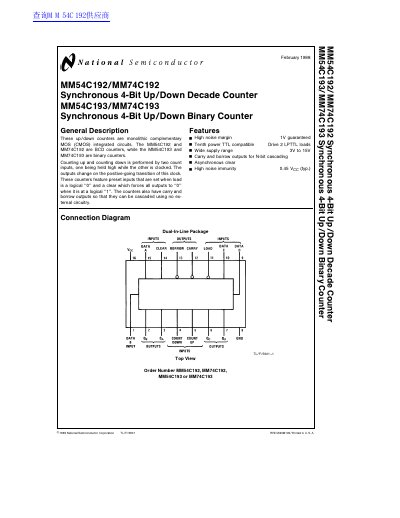
This document describes the MM54C192/MM74C192 Synchronous 4-Bit Up/Down Decade Counter and the MM54C193/MM74C193 Synchronous 4-Bit Up/Down Binary Counter. These are monolithic complementary MOS (CMOS) integrated circuits featuring preset inputs, asynchronous clear, and carry/borrow outputs for cascading.
| Supply Voltage Range | 3V to 15V |
|---|---|
| Operating Temperature Range (Military) | -55°C to +125°C |
| Operating Temperature Range (Commercial) | -40°C to +85°C |
| Maximum Count Frequency (Vcc=10V) | 10 MHz |
| Output Drive (Source) | 2 LPTTL loads |
The MM54C192 and MM74C192 are BCD counters, while the MM54C193 and MM74C193 are binary counters.
Yes, they have carry and borrow outputs so that they can be cascaded using no external circuitry.