
This paper provides a model and a tool for evaluating and improving the control loop characteristics of L6561-based PFC preregulators in boost topology and operated in Transition Mode (TM). The model can be used to evaluate the control loop performance of TM PFC preregulators and to optimize the design of TM PFC preregulators.
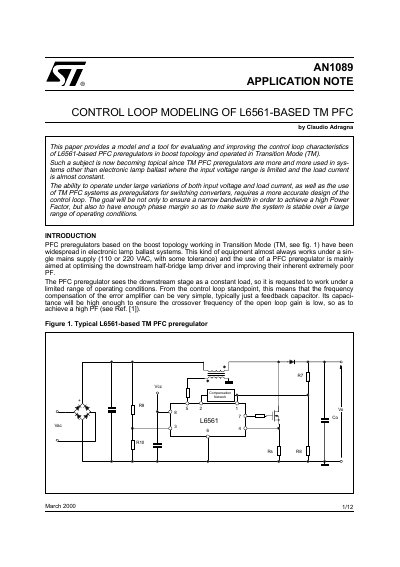
The document presents a mathematical model and analysis tool designed to evaluate and improve the control loop characteristics of PFC preregulators based on the STMicroelectronics L6561 chip. These devices are typically used in boost topologies operating in Transition Mode (TM). The note addresses the specific challenges of designing stable control loops for systems with wide variations in input voltage and load current, such as high-power AC-DC adapters and computer monitor power supplies.
The crossover frequency (fc) should not exceed 20-25 Hz at maximum mains voltage to ensure a high Power Factor.
The electrical characteristics specify Ku = 0.6 +25% at Vcomp = 4V, but Km actually decreases for low values of Vcomp.