
Introduces the current limitation functions of the two advanced PWM controllers L5991 and L5993 of ST, including pulse-by-pulse current limitation and current limitation mode. And gives a simple solution
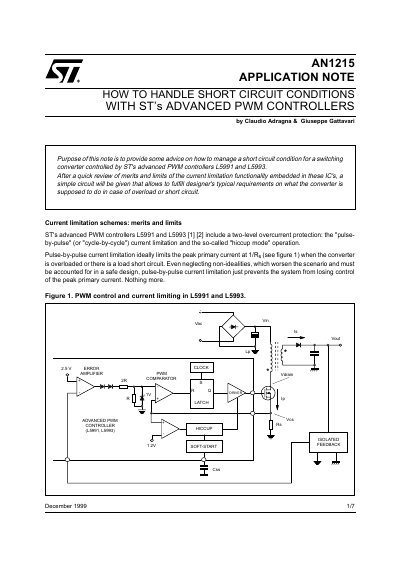
This document provides advice on managing short circuit conditions for switching converters controlled by STMicroelectronics' L5991 and L5993 advanced PWM controllers. It reviews the merits and limits of the built-in pulse-by-pulse current limitation and hiccup mode protection functions. The text explains that while pulse-by-pulse limitation prevents loss of control of peak primary current, it does not limit output current, which can lead to overheating. Hiccup mode is effective for internal faults but may not activate for external load shorts under certain conditions like low switching frequency.
Hiccup mode activates when the switch ON-time needed to control the peak primary current is lower than the minimum value Tonmin the controller can generate.
The typical value for Tonmin is 200 ns.
The hiccup functionality is triggered when the voltage on the current sense pin reaches 1.2V.