
This document introduces the technical notes on using Analog Devices' DSP components and development tools, mainly focusing on the ADSP-2191 Host Port Interface (HPI). The HPI is an 8- or 16-bit parallel, address and data multiplexed, asynchronous slave that provides a host processor with read/write access to all internal and external memory and IO (except IO page 0) spaces of the ADSP-2191. In addition, the ADSP-2191 can be 'booted' by the host processor. An application is described to demonstrate how to set up the bus for use with a host such as a second ADSP-2191 EMI port.
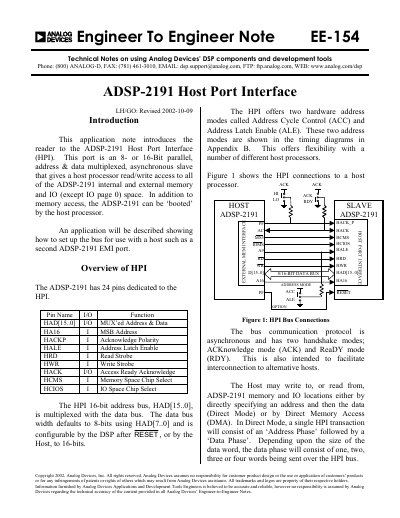
This document serves as a technical guide for using the Host Port Interface (HPI) on the ADSP-2191 Digital Signal Processor. It details the 24-pin interface, which allows a host processor to access the DSP's internal and external memory and I/O spaces. The note explains the asynchronous bus protocol, including Address Cycle Control (ACC) and Address Latch Enable (ALE) modes, as well as Acknowledge (ACK) and Ready (RDY) handshake configurations.
| Bus Width | 8- or 16-Bit parallel |
|---|---|
| Interface Type | Address & data multiplexed, asynchronous slave |
| Dedicated Pins | 24 pins |
| Address Bus | 16-bit (HAD[15..0]) |
The two hardware address modes are Address Cycle Control (ACC) and Address Latch Enable (ALE).
The active state is set by the logic level on the HACK P pin when the RESET pin goes inactive.
Yes, the HPI supports DMA transfers where internal configuration registers specify the destination address and number of words.