
This application note describes how to create and verify serial bus protocols using One Technology products.
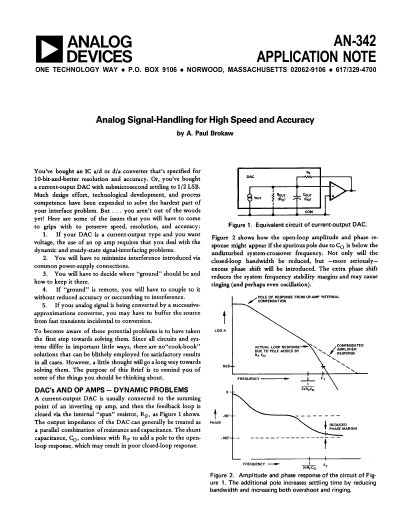
The document addresses common interface problems encountered when designing circuits with current-output DACs and operational amplifiers. Key challenges include managing dynamic signal-interfacing issues, minimizing interference from power supplies, establishing a stable ground reference, buffering sources for successive-approximations converters, and handling remote grounding scenarios.
Specific technical topics covered include the effects of spurious poles on loop stability, methods to restore margins using feedback capacitance, strategies for nulling op-amp offset voltage (Vos), and techniques for bypassing and decoupling in virtual-ground systems. The text provides guidance on circuit topology choices to minimize errors caused by variable output resistance in R-2R ladder DACs.
The shunt capacitance of the DAC combines with the feedback resistor to add a pole to the open-loop response, which may result in reduced bandwidth and excess phase shift.
Margins can be restored by connecting a feedback capacitor in parallel with the feedback resistor to create a zero in the open-loop transfer function.
The best way is to choose an op amp with low offset over temperature; otherwise, apply the correction as a voltage to the amplifier's positive input terminal.