
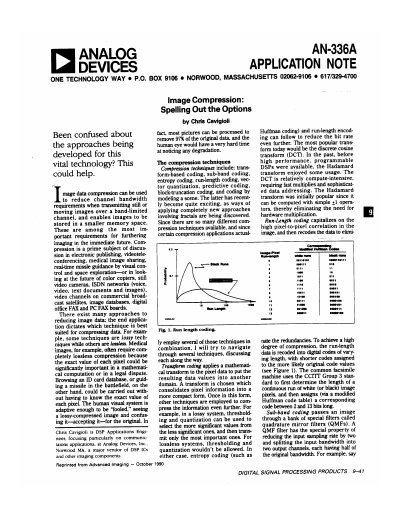
This document, titled Image Compression: Spelling Out the Options, discusses the importance of image data compression for reducing channel bandwidth and memory requirements in applications like videoteleconferencing and medical imaging. It distinguishes between lossy and lossless techniques based on the specific end application needs.
The text details several compression approaches, including transform-based coding (such as the discrete cosine transform), sub-band coding using quadrature mirror filters, and entropy coding methods like Huffman coding and run-length encoding. It also covers progressive coding and the JPEG standard, as well as video compression standards like H.261 for videotelephony.
Compression techniques include transform-based coding, sub-band coding, entropy coding, run-length coding, vector quantization, predictive coding, block-truncation coding, and coding by modeling a scene.
Medical images often require completely lossless compression because the exact value of each pixel could be significantly important in a mathematical computation or in a legal dispute.
The JPEG standard specifies a sequential DCT technique as its absolute minimum (baseline), where the algorithm performs compression tasks on the whole input image in a sequential fashion.