
The movement towards lower power supply voltages is driven by the demand for reduced power consumption and fewer power supply voltages in systems. Lowering power supply voltages has advantages including lower power consumption, space savings, and potentially eliminating the need for cooling fans. However, transitioning from traditional power supply voltages of ±15 V and ±12 V to lower voltages like ±5 V and +5 V and +3.3 V requires circuit designers to understand that designing in this new environment is more than finding components that can operate at lower voltages. Lowering the power supply voltage of an op amp reduces the signal swings and the required headroom between the signal and the rail.
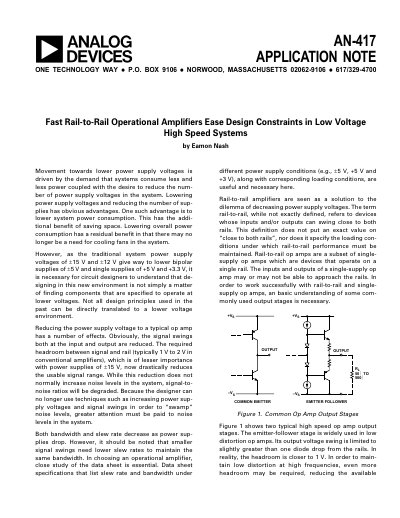
The document addresses the increasing trend towards lower power supply voltages (e.g., +5 V, +3.3 V) and single supplies, which creates design constraints for circuit designers. It explains that reducing supply voltage affects signal swings, noise levels, bandwidth, and slew rate, requiring careful component selection.
A rail-to-rail op amp is a device whose inputs and/or outputs can swing close to both power supply rails.
The optimal signal-to-rail headroom occurs when there is about 500 mV of space between the signal and each rail.
The safe input voltage range must be between -Vs and +0.5 V.