
BAT1000 is a 1A surface mount Schottky barrier rectifier with features of very low forward voltage drop and high conductance, suitable for use in DC-DC converter, PCMCIA and mobile telecommunications applications.
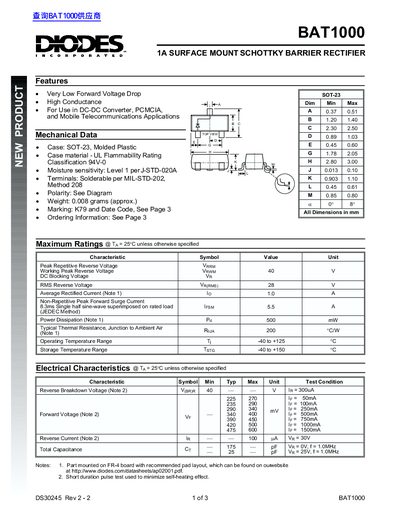
This document is a technical datasheet for the Diodes Incorporated BAT1000K AVS, a 1A Surface Mount Schottky Barrier Rectifier. The device features very low forward voltage drop and high conductance, making it suitable for DC-DC converters, PCMCIA applications, and mobile telecommunications.
The datasheet provides detailed mechanical data for the SOT-23 package, including dimensional drawings and terminal solderability specifications. It also lists maximum ratings such as peak repetitive reverse voltage of 40V and average rectified current of 1.0A, along with typical electrical characteristics like reverse breakdown voltage and total capacitance.
| Power Dissipation | 500 mW |
|---|---|
| Operating Temperature Range | -40 to +125 °C |
| Package Type | SOT-23 |
The device operates from -40 to +125 °C.
The maximum average rectified current is rated at 1.0 A.
It operates between -40 and +125 °C.