
The LP2950 and LP2951 are micropower voltage regulators with very low quiescent current and very low dropout voltage, making them ideal for battery-powered systems. The LP2950/LP2951 has been carefully designed to have a tight initial tolerance, excellent load and line regulation, and a very low output voltage temperature coefficient, making it suitable as a low-power voltage reference.
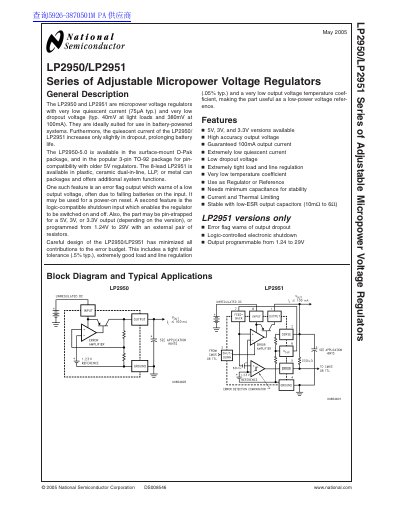
The LP2950 and LP2951 are micropower voltage regulators designed for battery-powered systems due to their very low quiescent current (75µA typ.) and very low dropout voltage. The LP2950 is available in 3-pin TO-92 and surface-mount D-Pak packages, while the LP2951 offers additional features like an error flag output and logic-controlled shutdown input in various package types including LLP, metal can, and ceramic dual-in-line.
| Quiescent Current (Typ) | 75µA |
|---|---|
| Dropout Voltage (100mA, Typ) | 380mV |
| Maximum Output Current | 100mA |
| Output Voltage Range (Programmable) | 1.24V to 29V |
| Initial Tolerance (Typ) | .5% |
| Load Regulation (Typ) | .05% |
The typical quiescent current is 75µA.
They are available in 3V, 3.3V, and 5V fixed versions.