
Determination of Trace Levels of PAHs in Food Grade Oils using Heart-cutting 2D-GC and Triple Quadrupole MS

Determination of trace levels of PAHs in food grade oils using heart-cutting 2D-GC and triple quadrupole mass spectrometry
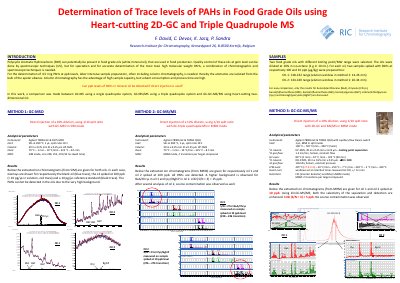

Determination of Trace Levels of PAHs in Food Grade Oils using Heart-cutting 2D-GC and Triple Quadrupole MS - cover page
Brand
Agilent
Document type
Other
Language
English
Pages
1
File format
PDF
File size
350 KB
Published
05 July, 2012
Updated
30 September, 2023
Model
2D-GC
MD5 checksum
33C4BB14F317329D18D1741012A36D37

About this manual

The text presents a scientific study comparing three chromatographic and spectroscopic techniques for determining trace levels of Polycyclic Aromatic Hydrocarbons (PAHs) in food-grade mineral oils. The methods evaluated include single quadrupole GC-MS, triple quadrupole GC-MS/MS, and heart-cutting two-dimensional gas chromatography coupled with mass spectrometry.

What's inside

  • Introduction
  • Method 1: GC-MSD
  • Method 2: GC-MS/MS
  • Method 3: GC-GC-MS/MS
  • Results and Discussion

Frequently asked questions

What is the limit of detection for PAHs when using the heart-cutting 2D-GC method?

The limit of detection is less than 5 ppb when the signal-to-noise ratio is 3.

What dilution ratio and solvent are used to prepare the oil samples for analysis?

The oils are diluted at 10% in iso-octane, using 1 gram of oil in 10 mL of solvent.

Which specific PAH compounds are discussed in the results section?

The results focus on benzo(a)anthracene, chrysene, benzo(b)fluoranthene, benzo(k)fluoranthene, benzo(a)pyrene, indeno(123cd)pyrene, and benzoghi)perylene.

Download PDF (350 KB)

More Agilent Manuals


View all Agilent manuals →