
The advantages of automating sample derivatization are presented, including increased productivity and reduced cost. Examples of sample derivatization with fatty acids, pentachlorophenol, and morphine are provided. Silylation derivatization of fatty acids improves peak shape and resolution.
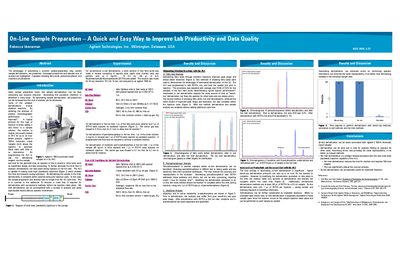
The document presents a method for improving laboratory productivity by automating common, time-consuming sample preparation tasks like silylation. It highlights that using the Agilent 7693A Automatic Liquid Sampler (ALS) allows operators to automate derivatization with little intervention, freeing them for other tasks such as experiment design and data processing.
Two primary methods of automation are discussed: automated in-vial derivatization and hot inlet derivatization. The latter involves performing the reaction during the injection cycle within the GC inlet, significantly reducing total analysis time from over 15 minutes to just seconds. Examples using fatty acids, pentachlorophenol, and morphine illustrate how this approach improves peak shape, resolution, and reproducibility while reducing reagent consumption.
Automating this procedure increases lab productivity, decreases the cost of analysis, reduces operator errors, and improves reproducibility.
Conventional methods require 15 minutes or more before injection, whereas hot inlet derivatization completes within seconds during the injection cycle.
On-line derivatization uses only 1 µL of BSTFA per injection, whereas conventional methods typically use at least 100 µL for a 0.5 mL sample.