
This document describes the use of Varian CP-4900 Micro GC and provides an example of how to use the EDU-Varian Sample Concentrator to concentrate samples to improve the detection limit.
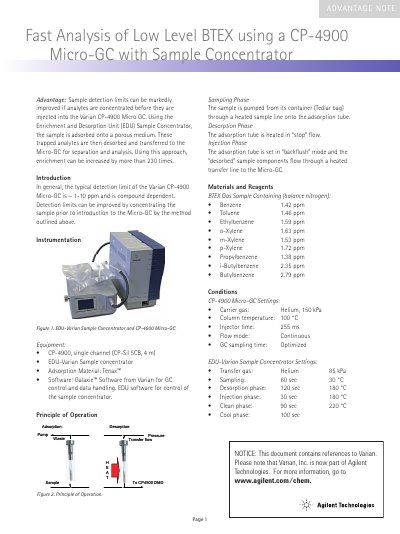
This document details a method for improving the detection limits of the Varian CP-4900 Micro-GC (now Agilent) by using the Enrichment and Desorption Unit (EDU) Sample Concentrator. The system adsorbs analytes onto a Tenax porous medium before desorbing and transferring them to the Micro-GC for separation and analysis.
| Carrier gas | Helium, 150 kPa |
|---|---|
| Column temperature | 100 °C |
| Injector time | 255 ms |
| Flow mode | Continuous |
| Transfer gas | Helium 85 kPa |
| Sampling time | 60 sec 30°C |
| Desorption phase | 120 sec 180 °C |
| Injection phase | 30 sec 180 °C |
| Clean phase | 90 sec 220°C |
| Cool phase | 100 sec |
The typical detection limit is approximately 1-10 ppm, depending on the compound.
The detection limit can be improved from 1 ppm to 5 ppb for several aromatic compounds.
Enrichment factors as much as 230 times or more can be obtained depending on the sample component and conditions.
The adsorption material used is Tenax™.