
This document describes some of the lessons learned from using a flow modulator to modulate methane and points out some common erroneous assumptions, such as that stationary phase bleed is a good indicator of hold-up time. When using this approach to perform fundamental retention studies, one cannot escape the fundamental pitfalls of capillary chromatography. Loss of He through fused-silica at high temperatures and low flows can cause significant errors.
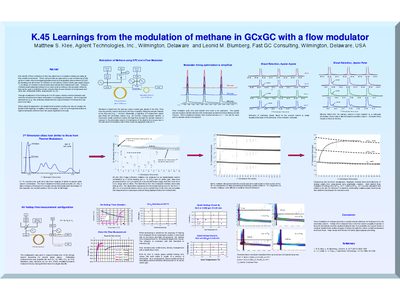
This document presents findings by Matthew S. Klee and Leonid M. Blumberg regarding the benefits of using a flow modulator to inject and modulate methane in GCxGC systems. The study highlights how this technique allows for easier modulation with less complex components compared to thermal modulators, facilitating the investigation of internal chromatographic phenomena.
They allow one to modulate methane easily with less complex components.
It provides an opportunity to use methane as a holdup time reference, allowing for faster and easier investigation of retention behavior.