
Philips 74HC/HCT4060 14-Stage Binary Ripple Counter with Oscillator Datasheet

74HC/HCT4060 is a 14-stage binary ripple counter with oscillator
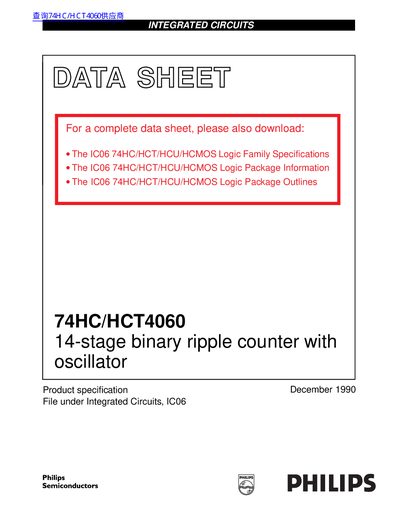

Philips 74HC/HCT4060 14-Stage Binary Ripple Counter with Oscillator Datasheet - cover page
Brand
Philips
Category
Other Electronics
Document type
Datasheet
Language
English
Pages
12
File format
PDF
File size
78 KB
Published
02 July, 2012
Updated
01 October, 2023
Model
74HC
MD5 checksum
B274D7E09FB831AAE81A49041FF45E51

About this manual

The Philips 74HC/HCT4060 is a high-speed Si-gate CMOS device featuring a 14-stage ripple-carry counter/divider and an on-chip oscillator. It includes ten buffered outputs (Q3 to Q8 and Q11 to Q13) and an overriding asynchronous master reset (MR). The device is pin compatible with the '4060' of the '4000B' series and complies with JEDEC standard no. 7A.

What's inside

  • Features
  • General Description
  • Quick Reference Data
  • Pin Description
  • Dynamic Power Dissipation
  • DC Characteristics
  • AC Characteristics
  • Applications
  • Timing Diagrams
  • Package Outlines

Specifications

Device Type14-stage binary ripple counter with oscillator
Technologyhigh-speed Si-gate CMOS
Output Capabilitystandard (except for Rtc and Cyc)
Logic CategoryMSI

Frequently asked questions

Is the 74HCT version TTL compatible?

Yes, in the HCT version, the MR input is TTL compatible, while the RS input has CMOS input switching levels.

What is the maximum clock frequency for the 74HC/HCT4060?

The maximum clock frequency is 88 MHz for the HCT version and 87 MHz for the HC version.

What is the recommended minimum value for the resistor R1 in an RC oscillator circuit?

To avoid start-up problems, the resistor R1 should be set to 1 kΩ.

What is the minimum capacitance required for the external capacitor C1 in an RC oscillator?

The capacitor C1 must be larger than 50 pF to maintain agreement with the typical oscillation formula.

Download PDF (78 KB)

More Philips Manuals


View all Philips manuals →