
This document describes a method for separating carbazole and its metabolites using the Agilent ZORBAX 300 SB-C18 column at low pH. The method achieves resolution of peaks 1 and 2 that was not previously possible, and provides stable and reproducible chromatography at pH < 1.
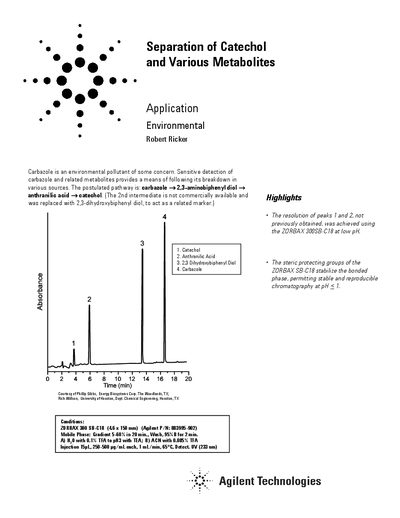
The document details an analytical method for detecting carbazole and its related metabolites, which are environmental pollutants. The postulated breakdown pathway involves intermediates such as anthranilic acid and catechol.
Successful resolution of the peaks was achieved using a ZORBAX 300SB-C18 column operating at low pH (<1). This condition stabilizes the steric protecting groups of the bonded phase, ensuring stable and reproducible chromatography.
The application uses a ZORBAX 300 SB-C18 column with dimensions of 4.6x 150 mm.
The procedure requires an injection volume of 15pL.