
The document mainly introduces the application range, characteristics and detection performance of Agilent Refinery Analyzer product. It can be used to analyze oxygenates in butane feed stocks, gasoline and naphtha
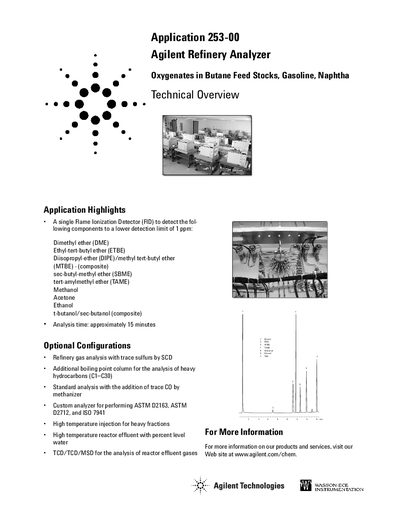
This document provides a technical overview of the Agilent Refinery Analyzer, model 253-00. The instrument utilizes a single Flame Ionization Detector (FID) to detect specific oxygenate components in butane feedstocks, gasoline, and naphtha with a detection limit of 1 ppm. The analysis time for these components is approximately 15 minutes.
| Detection Limit | 1 ppm |
|---|---|
| Analysis Time | approximately 15 minutes |
| Detector Type | Flame Ionization Detector (FID) |
| Detected Components | DME, ETBE, DIPE/MTBE, SBME, TAME, Methanol, Acetone, Ethanol, t-butanol/sec-butanol |
The analyzer detects Dimethyl ether (DME), Ethyl-tert-butyl ether (ETBE), Diisopropyl-ether (DIPE)/methyl tert-butyl ether (MTBE), sec-butyl-methyl ether (SBME), tert-amylmethyl ether (TAME), Methanol, Acetone, Ethanol, and t-butanol/sec-butanol.
The analysis time is approximately 15 minutes.
Yes, trace sulfurs can be detected via an optional SCD configuration.