
The NCP101X series integrates a fixed-frequency current-mode controller and a 700V MOSFET, suitable for low standby-power offline SMPS. It features soft-start, frequency jittering, short-circuit protection, skip-cycle, maximum peak current setpoint, and dynamic self-supply.
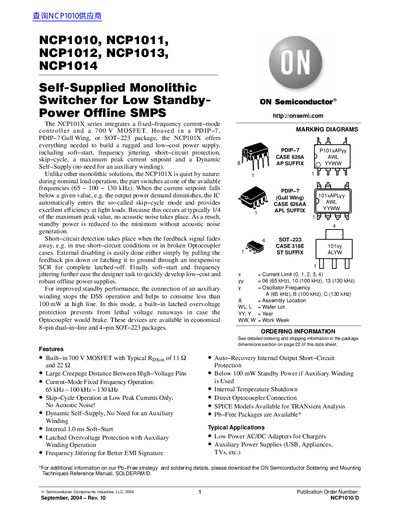
The NCP101X series integrates a fixed-frequency current-mode controller and a 700 V MOSFET, designed for low standby-power offline SMPS applications. The devices are available in PDIP-7, PDIP-7 Gull Wing, or SOT-223 packages and offer features such as soft-start, frequency jittering, short-circuit protection, skip-cycle operation, and dynamic self-supply without the need for an auxiliary winding.
These controllers are suitable for low power AC/DC adapters and auxiliary power supplies. They operate at frequencies of 65 kHz, 100 kHz, or 130 kHz and include internal temperature shutdown and direct optocoupler connection. When an auxiliary winding is used, standby power can be reduced to below 100 mW at high line voltage.
| Built-in MOSFET Voltage | 700 V |
|---|---|
| Operating Frequencies | 65 kHz, 100 kHz, 130 kHz |
| Maximum Junction Temperature | 150 °C |
| Soft-Start Time | 1.0 ms |
| Standby Power (with Auxiliary Winding) | Below 100 mW |
| Package Types | PDIP-7, PDIP-7 Gull Wing, SOT-223 |
No, the devices feature Dynamic Self-Supply, meaning there is no need for an auxiliary winding.
Short-circuit detection takes place, which occurs in true short-circuit conditions or in broken Optocoupler cases.