
This article describes the characterization of ubiquitin and its digested products under oxidative stress using mass spectrometry analysis. The study reveals the presence of peroxidation products of ubiquitin in Alzheimer's disease. The peroxynitrite treated ubiquitin products were analyzed and confirmed using full scan mass spectrometry analysis and enzymatic digestion. The results provide direct evidence for the pathogenesis of Alzheimer's disease and the impact of oxidative stress.
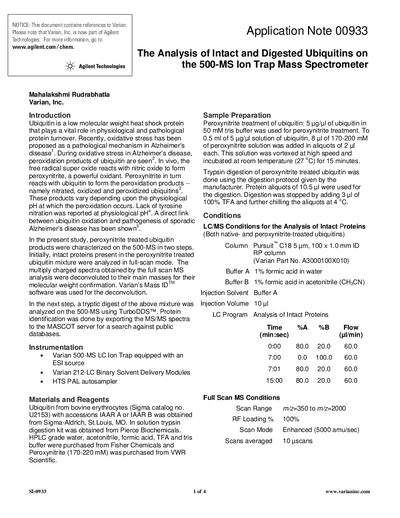
This document details a study characterizing peroxynitrite-treated ubiquitin products using the Varian 500-MS. The analysis involved full-scan mode to confirm molecular weights of intact proteins and TurboDDS™ for tryptic digest analysis to identify the protein sequence against public databases.
| Scan Range | m/z=350 to m/z=2000 |
|---|---|
| Scan Mode | Enhanced |
| Scans averaged | 10 scans |
| Survey Scan Range | m/z=200 to m/z=2000 |
| RF loading | 100% |
| MS2 Depth | 2 |
| Isolation window | 3.0 m/z |
| Breadth | 5 |
| Dynamic exclusion | yes |
Varian's Mass iID™ software is used for the deconvolution.
Protein identification is done by exporting the MS/MS spectra to the MASCOT server for a search against public databases.
Excellent peptide sequence coverage of 92% was obtained at low concentrations.