
Agilent 725-ES Soil Extract Analysis Application Note

This paper describes the method of analyzing soil extracts using the Agilent 725-ES Inductively Coupled Plasma-Optical Emission Spectrometer. By analyzing the content of micronutrients in soil samples, the nutrient levels available for plants can be assessed, providing an indication of possible nutrient deficiency. The article describes the analysis of different soil extracts using ICP-OES technique.
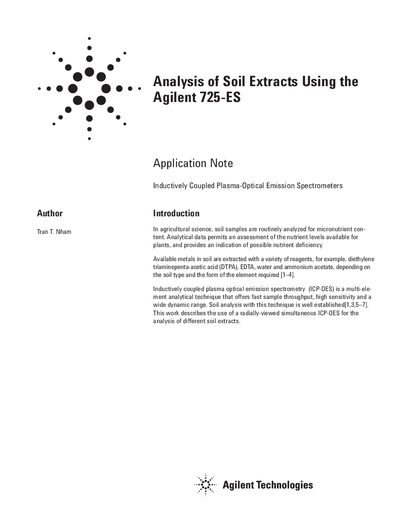

Agilent 725-ES Soil Extract Analysis Application Note - cover page
Brand
Agilent
Document type
Application Note
Language
English
Pages
4
File format
PDF
File size
148 KB
Published
12 June, 2012
Updated
29 September, 2023
MD5 checksum
7625C0BC10282E65BD7B4A8BDE14CF4B

About this manual

The document details a method for analyzing soil samples for available metals such as Zinc, Iron, Manganese, Copper, Sodium, Potassium, Calcium, Magnesium, and Sulfur. It utilizes Inductively Coupled Plasma Optical Emission Spectrometry (ICP-OES) to assess nutrient levels in agricultural science.

What's inside

  • Introduction
  • Instrumentation
  • Reagents and Standards
  • Preparation of Extraction Solutions
  • Preparation of Soil Sample Extracts
  • Wavelength Selection
  • Results and Discussion

Frequently asked questions

What is the method detection limit for Calcium (Ca) at 422.673 nm?

The estimated method detection limit is 15 g/L.

What is the recommended wavelength for Sulfur (S) analysis to avoid calcium interference?

The primary line at 181.972 nm is recommended over the secondary line.

What gas can be used to purge the polychromator for low UV measurements?

The polychromator can be purged with either argon or nitrogen gas.

Download PDF (148 KB)

More Agilent Manuals


View all Agilent manuals →