
HWS341 GaAs MMIC SPDT high power switch is a high performance switch from HW company. This switch is made by GaAs technology, and has the features of high performance, high reliability and low power consumption. It is suitable for various communication, industrial and military applications.
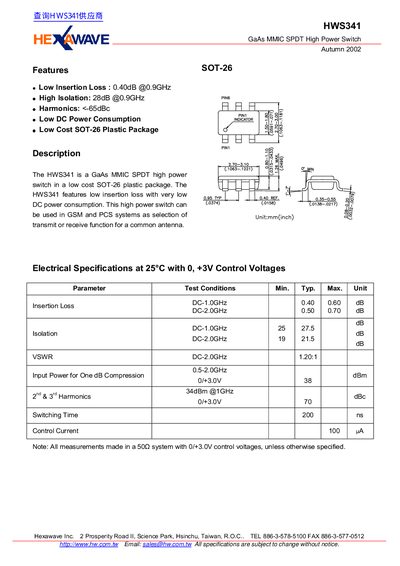
The HWS341 is a GaAs MMIC SPDT high power switch available in a low cost SOT-26 plastic package. It features low insertion loss and very low DC power consumption, making it suitable for use in GSM and PCS systems for selecting transmit or receive functions on a common antenna.
The document provides detailed electrical specifications at 25°C with 0/+3V control voltages, including insertion loss, isolation, VSWR, and input power for one dB compression. It also lists absolute maximum ratings for RF input power, control voltage, and operating temperature, along with typical performance graphs for insertion loss, isolation, VSWR, and harmonic rejection.
| Package Type | SOT-26 Plastic Package |
|---|---|
| Insertion Loss (DC-1.0GHz) | 0.40 dB (Typ) |
| Operating Temperature | -40°C to +85°C |
| Switching Time | 200 ns |
| Control Current | 100 uA |
The absolute maximum RF input power is +38dBm for the 0.5-2.0GHz range.
The recommended control voltage is 0/+3V, with Veigh ranging from +3V to +5V.
Yes, DC blocking capacitors Cs are required on all RF ports.