
LTC1258-3/LTC1258-4.1 are micropower bandgap references that combine high accuracy and low drift with very low supply current and small package size. The combination of ultralow quiescent current and low dropout voltage of only 200mV max makes them ideal for battery-powered equipment. These references uses curvature compensation to obtain low temperature coefficient and trimmed thin-film resistors to achieve high output accuracy. These references can supply up to 10mA and sink up to 2mA, making them ideal for precision regulator applications.
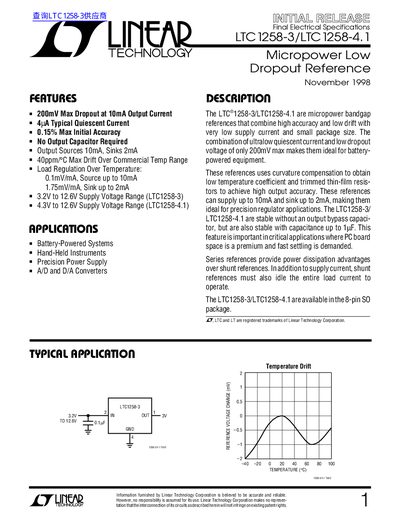
The LTC1258-3 and LTC1258-4.1 are micropower bandgap references designed for battery-powered systems and precision applications. They combine high accuracy with very low supply current and small package size, making them ideal for use with A/D and D/A converters.
| Quiescent Current | 4uA Typical |
|---|---|
| Initial Accuracy | 0.15% Max |
| Dropout Voltage | 200mV Max at 10mA |
| Supply Voltage Range (LTC1258-3) | 3.2V to 12.6V |
| Supply Voltage Range (LTC1258-4.1) | 4.3V to 12.6V |
| Output Current (Source) | 10mA |
| Output Current (Sink) | 2mA |
| Temperature Drift | 40ppm/°C Max |
| Package | 8-pin SO |
No, the device is stable without an output bypass capacitor.
The maximum dropout voltage is 200mV at 10mA output current.
The typical quiescent current is 4uA.