
The ADA4922-1 is a high voltage, differential 18-bit ADC driver that provides single-ended input and can produce differential output signals in excess of 40 V p-p. It features a 38 MHz bandwidth and a 200 ns fast settling time.
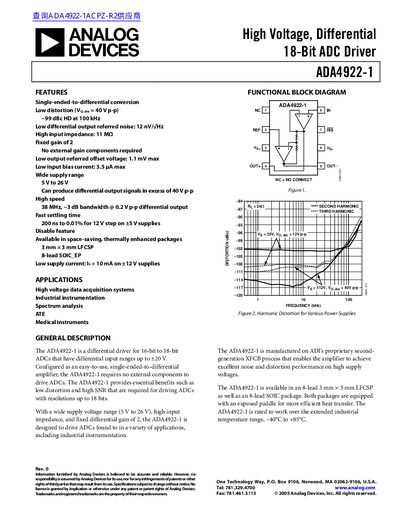
The ADA4922-1 is a differential driver designed for 16-bit to 18-bit ADCs with differential input ranges up to +20 V. Configured as an easy-to-use, single-ended-to-differential amplifier, it requires no external components to drive ADCs and provides essential benefits such as low distortion and high SNR.
The device operates over a wide supply voltage range of 5 V to 26 V with a fixed differential gain of 2. It is available in space-saving 3 mm x 3 mm LFCSP and 8-lead SOIC packages, both equipped with an exposed paddle for efficient heat transfer.
| -3 dB Bandwidth (Vo = 0.2 V p-p) | 38 MHz |
|---|---|
| -3 dB Bandwidth (Vo = 40 V p-p) | 6.5 to 7.2 MHz |
| Slew Rate (Vo,am = 2 V step) | 260 V/us |
| Settling Time to 0.01% | 580 ns |
| Differential Output Offset Voltage | 1.1 mV max |
| Input Bias Current | 3.5 pA max |
| Gain | 2 V/V |
| Operating Supply Range | 5 to 26 V |
The device has a fixed differential gain of 2.
No, it requires no external components to drive ADCs.
The device can produce differential output signals in excess of 40 V p-p.